
Lagoon-Side Residence — Full Architectural Tour
The House That Changes When You Look Again: Watching Lagoon-Side Residence as Cinema
Try an unusual thing when watching Lagoon-Side Residence — Full Architectural Tour: remember the first encounter with its water before deciding what the house is about. Then, when the film presents the upper gallery, ask whether the object you remember is the lagoon, the building, or the distance between your imagined position and the water. The answer may change. What seemed at first to be the subject of an exterior portrait has become a device for understanding the interior. This is the kind of change that a sequence of architectural images can accomplish and that even a remarkably accomplished individual rendering cannot deliver by itself.

The film is an original fictional AI-designed architectural concept, not a record of an identified building. Our subject is the experience of watching that concept unfold. The twelve approved narration passages and their linked approved scene-image evidence establish the architectural elements discussed here; this linkage does not imply a separate approval of an independently authored scene plan. They do not provide the camera trajectories, individual shot lengths, lens settings, a measured plan, or a color-graded master for frame-by-frame analysis. Consequently, the following is an interpretation of the narrated visual sequence, not a report of measured cinematography or proof of anything constructed.
Rather than retracing the tour as a succession of rooms, this feature groups moments according to what they ask an audience to remember, compare, and imagine. A kitchen can help us understand an exterior silhouette; a bathroom can alter our reading of the great window in an entirely different room. The day drawing to its close can tell us something about an introduction that has long since left the screen. The point of rewatching is not to discover a larger inventory of features. It is to discover how the images become more informative in one another's company.
1. The image that comes back with a different meaning
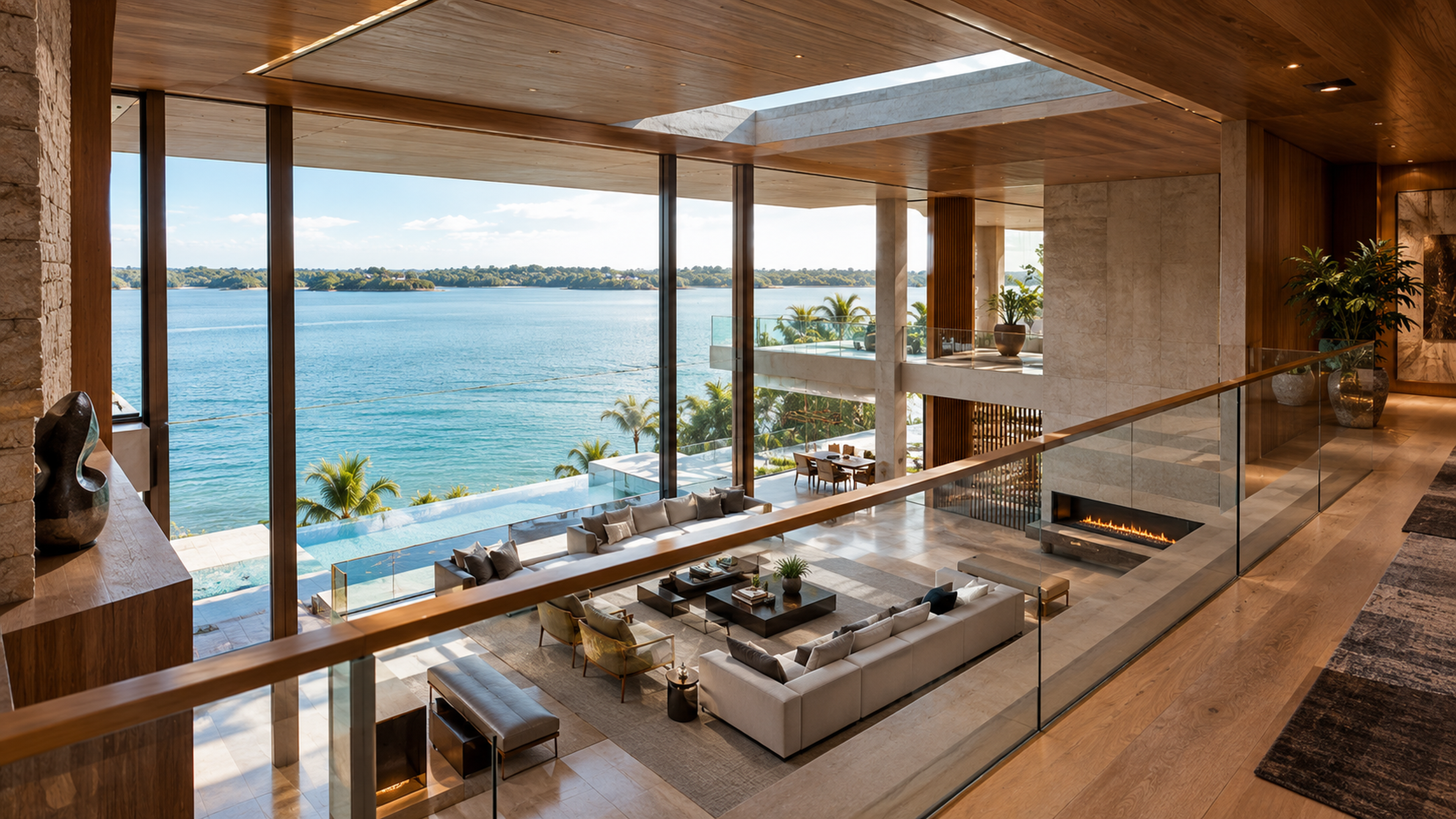
Take two episodes that are separated in the tour: the living space in the fifth passage and the upper gallery in the ninth. The narration identifies a glazed elevation extending through two levels in the former, and an elevated, protected position associated with the living volume in the latter. These two views are particularly valuable when considered together. We have a chance to change our interpretation of a place without needing to introduce an entirely new visual subject. The gallery is evidence of a relationship that a viewer could only partially understand earlier. The gap between encounters is part of the effect.
Imagine cutting a short architectural reel down to just a dramatic interior portrait. Such an image might suggest great height. It would not necessarily convey how an elevated route fits into the space represented. For that we require a second encounter that makes the height relational. A person looking across the upper part of the volume would understand something different from someone who imagines being at living-room level. The subsequent gallery passage provides the conceptual counterpart to that earlier perspective. It is not necessary to know exactly where a virtual camera was placed for us to appreciate the change in spatial knowledge.
This gives the viewer a concrete experiment. Watch the living-room passage and make a simple mental note about the water's role. Is it something at the far end of the room? Is it almost the background of the entire image? Does it seem accessible, or primarily visible? Do the same with the gallery. There is no compulsory answer to these questions. They concern the experience of each audience member as much as the concept. A successful relationship between the two episodes would allow that viewer to recognize the shared outlook and also register that the relation to it has shifted. If one only remembers a second beautiful expanse of water, something about the explanatory work of the sequence has been missed.
In editing terms, repetition is not necessarily redundancy. An image gives back information about an earlier image when the audience can establish a connection between them. Returning to a motif can be more rewarding than continually presenting novel subjects. There is also a balance to strike: repeat the exact standpoint without a perceptible change and the second image contributes little; remove all reference to the earlier one and the viewer has to construct the relationship from nothing. The paired living and gallery descriptions suggest a middle possibility, recognizable continuity with an altered point of apprehension. The new information belongs to the viewer, not simply to the list of rooms.
The relationship can be observed without converting the gallery into a floor plan. Its narrated position above the living space tells us something about where to place it in our mental construction, but not where every opening, junction, or support belongs. A precise reconstruction drawn from this alone would project a confidence the source does not warrant. The useful thing to retain is a simple relation: two positions give access to knowledge of a common architectural volume. That is sufficient to change the spectator's understanding of the fictional house.
There is a curious consequence for how people share architectural imagery. If one selects the most magnificent image for a still, the chosen representation may lose the very relationship that makes the film memorable. A pair of less spectacular images, arranged as a before-and-after discovery, might explain far more. For this particular film an editorial double-page spread could juxtapose living-level and gallery-level interpretations, for instance. It would not need to claim an identical lens, a measured section, or a matched photographic position. The shared subject and changed point of observation give the pairing its purpose. This is one reason to watch the film itself rather than rely on a single visual excerpt.
2. When the edge of the image starts doing the work
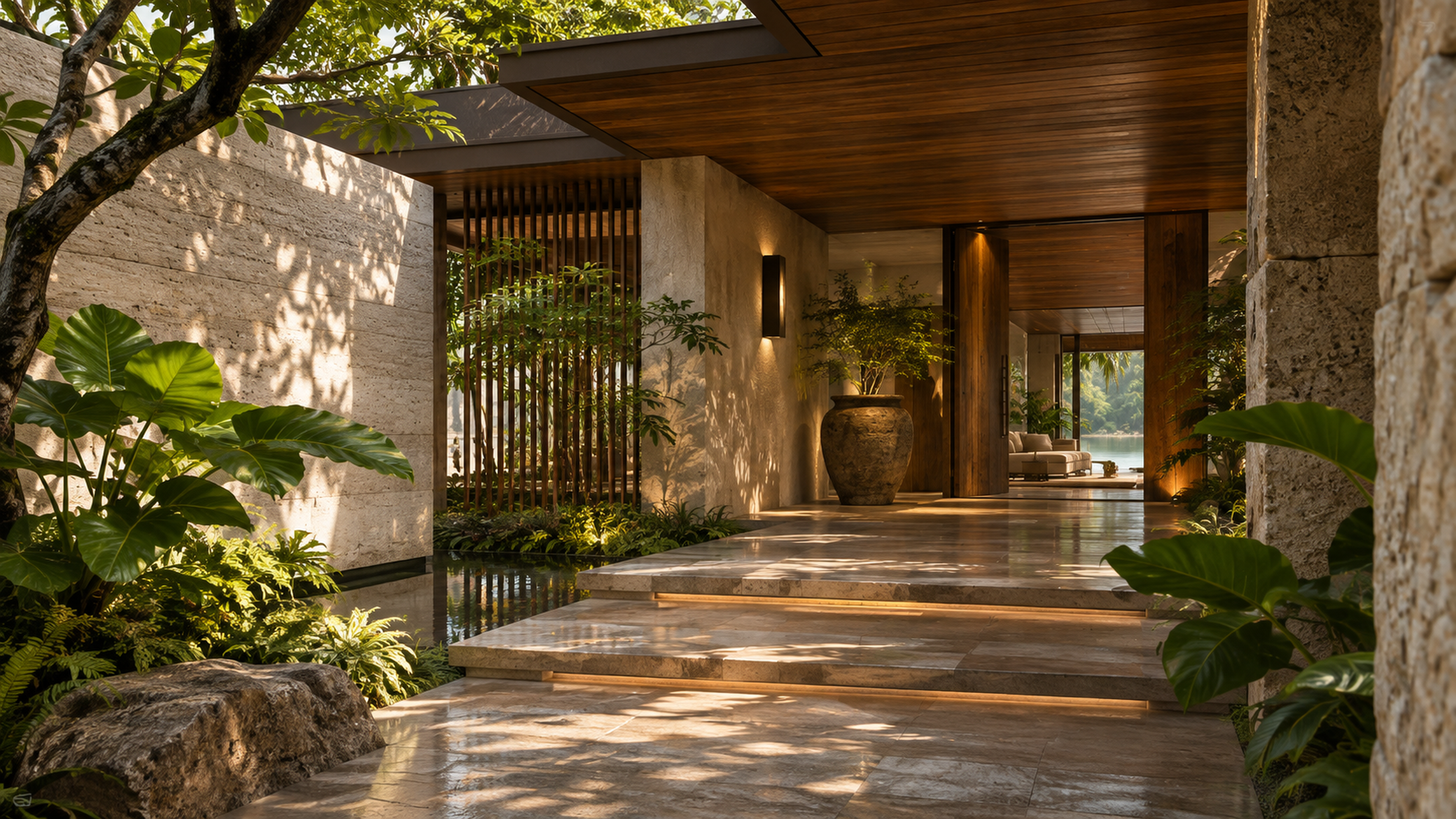
The eye can be directed toward something without placing it in the absolute center of a frame. An element that partly encloses the image may tell us how to look at what lies beyond it. The bronze screens and recessed entrance of passage two, the outer covering associated with the terrace of passage eight, and the garden-directed outward connection of the bath in passage eleven suggest quite different opportunities for that kind of visual direction. They are not identical objects. They share the capacity to make a spectator aware of a boundary before allowing attention to travel farther.
Consider first the entrance. Because the source identifies metal screens together with strongly textured stone and a recessed opening, a close interpretation of this place has a choice. It can distribute those elements evenly across a composition, or allow one of them to interrupt the spectator's immediate access to the others. A partial screen in the foreground, for example, could become a perceptual obstacle that encourages the audience to search the scene. Such a composition would be a possible new illustration, not a claim about the actual framing of the film. Its advantage would be to make the entrance intelligible through the act of looking rather than through a diagram of the facade.
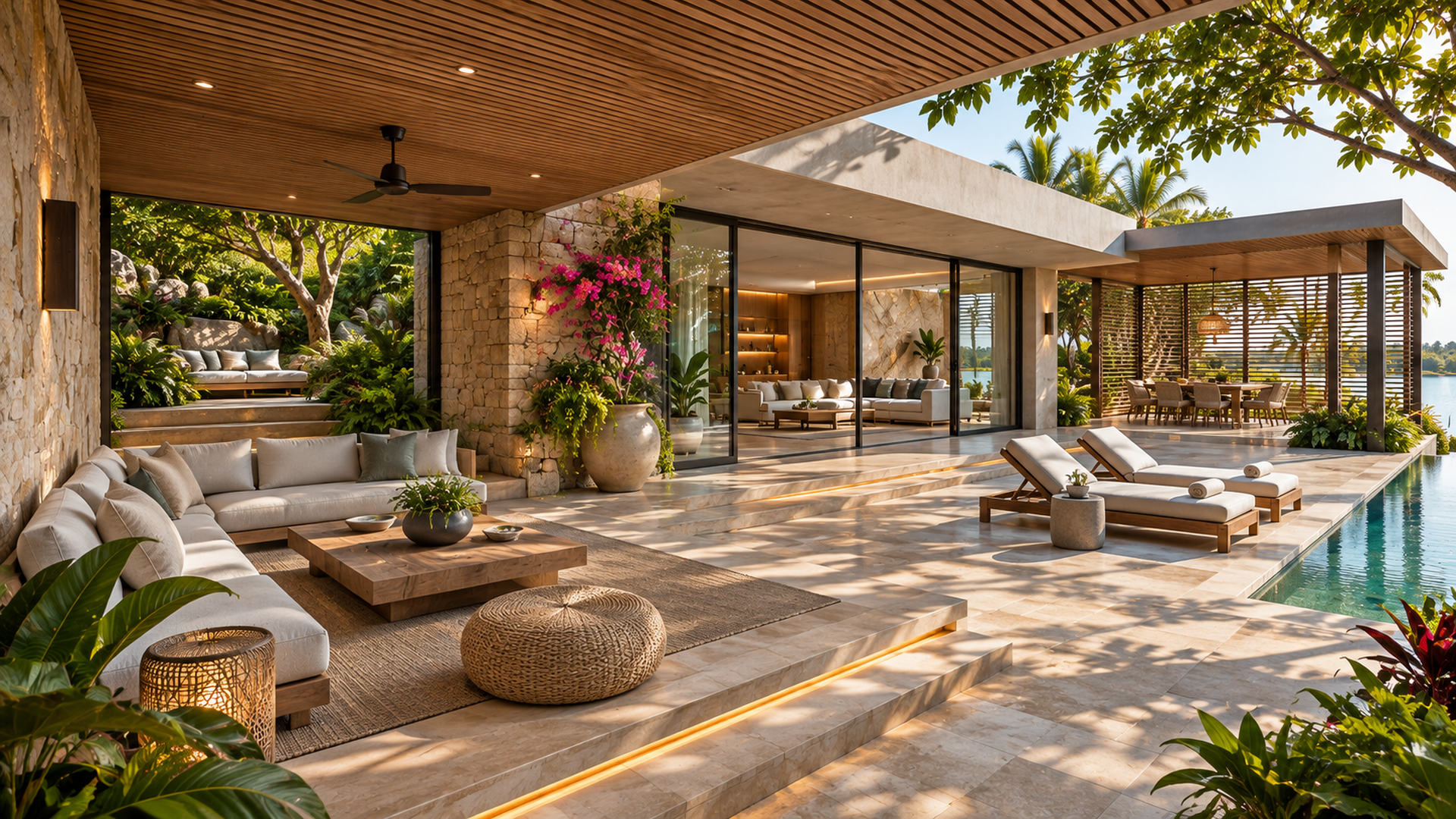
The same experiment applied to the terrace produces a different result. A roof edge can be allowed to enter the upper portion of an image while the distance beyond remains open to view. The amount of covering visible would affect whether an audience experiences an exterior position as contained or exposed. Too little foreground context and the scene might simply be interpreted as a view of the lagoon. Too much context and the audience might lose the sense of being outdoors. In an interpretive composition the protected glazing and stone associated with this passage are additional clues to the spectator's imagined location. They could help differentiate a view from within the interior from one conceived at an exterior edge.
The bath provides something closer to a test of omission. The outward reference is a protected garden window, not the broad lagoon prospect that dominates some of the other descriptions. This is an important change for the image itself. An editor who tried to maximize the apparent grandeur of every scene might feel obliged to bring the lagoon back into the bath illustration. That would sacrifice the distinction supplied by the approved narration. The garden is significant precisely because it changes what the spectator is asked to look toward. There is no need to invent a connected courtyard, special landscaping pattern, full-height window, or a view of the water hidden behind the garden. A good visual interpretation can let the smaller, more limited outward reference remain the subject.
Framing also establishes an ethics of representation. Cropping away an awkward-looking element may improve a visual composition, but removing the evidence that makes a location comprehensible can change the architectural statement. An entrance stripped of its recession and screen, or an upper gallery portrayed without its protective boundary, would lose some of the information that distinguishes these places. The image-maker should be attentive to what needs to remain in view even when an uncluttered picture is desired. The same principle applies to an article's illustrations: restraint should not be achieved by discarding source facts.
Watch for how much of an image is devoted to things through which, past which, or alongside which you imagine looking. A frame that contains several depth intervals can suggest a position within architecture much more clearly than one in which everything seems to occupy the same distant plane. The approved passages support the possibility of multiple intervals without proving any particular focal length. The difference is between a picture that simply contains a house and an image that invites you to locate yourself in relation to the house. It is one of the most interesting questions to carry from the entrance to the terrace and then to the garden-directed bath.
3. A mental edit between the table and the stair
Consider a second deliberately nonchronological pairing. Put the fourth narration passage, with its generous stair treads, landing and guard, next to the seventh, where a table occupies a dining area beneath a descending roof form. Neither is primarily about discovering another distant feature of the site. Both contain cues to the scale of imagined human activity, but they suggest very different patterns of time. One invites the spectator to conceive a person changing position; the other invites the spectator to imagine a person remaining in relatively the same position while attending to others.
This is a useful challenge for a film without a documented actor-driven plot. Architecture can imply human action without depicting it explicitly. A series of treads sets up an expectation of successive steps. A landing interrupts that pattern, and a guard signals the presence of an edge that requires recognition. The source gives us those three pieces of information. In a still interpretation, one may select a composition that helps the spectator visually trace available movement rather than attempting to show an athletic ascent or a floating stair stripped of its protective details. The interest lies in the imaginary passage of a body through the composition.
At a dining table attention might work in nearly the opposite manner. The concept specifies the lower roof condition and an ongoing connection to water. One can imagine a seated observer letting the view recede into the background of a social encounter, then bringing it to the foreground again with a glance. That hypothetical experience does not establish a seating arrangement or a particular dinner scene. It gives the table an expressive role in the visual sequence: a point around which attention circulates while bodies might remain stationary. A movie can evoke the difference between these modes without introducing a story about the occupants.
Thinking in terms of visual verbs rather than nouns is useful here. Instead of labeling two images stair and dining room, an editor could assign the verbs trace and linger. These words suggest decisions about what should remain legible in a new image and what should not compete for attention. In a representation of the stair, an isolated close detail of a smooth finish would provide little evidence of the journey promised by the narration. A dining image that suppresses the relation between roof and table would similarly miss the distinctive subject of its passage. The two frames need different emphases even if both are styled consistently.
It would be a mistake to identify the suggested rhythms with the actual time taken by the camera. The approved dossier does not specify whether the images pan, move, dissolve, or remain still for a given number of seconds. Nor does a viewer's impression of movement establish the nature of an accessible route. There is a distinction between looking across an image of movement and undertaking that movement physically. Here the stair can furnish visual evidence of an anticipated action, not a certification that someone could perform it safely. The same distinction holds for any imagined meal in the dining room.
A viewer who pauses the film on these passages can compare the distances the eye seems to travel. The stair presents repeated visible intervals and an anticipated destination; the table offers a recognizable object around which to collect attention. In the first case one's reading may advance through the architecture, while in the second it may make small excursions between local detail and a more distant outlook. Neither is better. Both are kinds of cinematic time that architectural image-makers have available even before they decide whether a camera should move. This pairing reveals a dimension of the concept that is easy to overlook if every scene is evaluated solely for its isolated visual impact.
4. The material changes because the spectator comes closer
There is a special problem with judging materials through architectural films: an object covering a large area in one image may be represented by a very small patch of color in another. A spectator is expected to combine evidence acquired at several scales. In this film the opening exterior establishes stone at the base of an extended composition, whereas the northern kitchen and the private bath make stone and oak part of much smaller encounters. This is a productive sequence for considering what happens to material perception as an imagined position within a house changes.
In a distant portrait, the main evidence of differing substances often comes from contrasts in tone, silhouette, and the junctions between large fields. One can see a visually substantial base without being able to inspect its surface. As an illustration moves into a domestic interior, the viewer can become more aware of surface variation and of the area occupied by smaller elements. Oak is named specifically in the kitchen and bath; the film does not require us to treat every warm-colored surface elsewhere as oak. The recurrence of named materials makes a comparison possible without collapsing different interiors into a single invented finish specification.
One approach to rewatching is to disregard color temporarily. Pay attention instead to where surfaces begin and end, and to what scale of visual evidence each passage supplies. Can you distinguish the edge of a relatively small object from the continuation of a broad plane? Is a surface readable because of its position beside something differently toned? Are the material indications so indistinct that the room has become an abstract arrangement of colors? These questions could be applied to AI-designed imagery, physical architectural photography, or a film mixing both. They can sharpen an audience's perception before the conversation turns to aesthetics or cost.
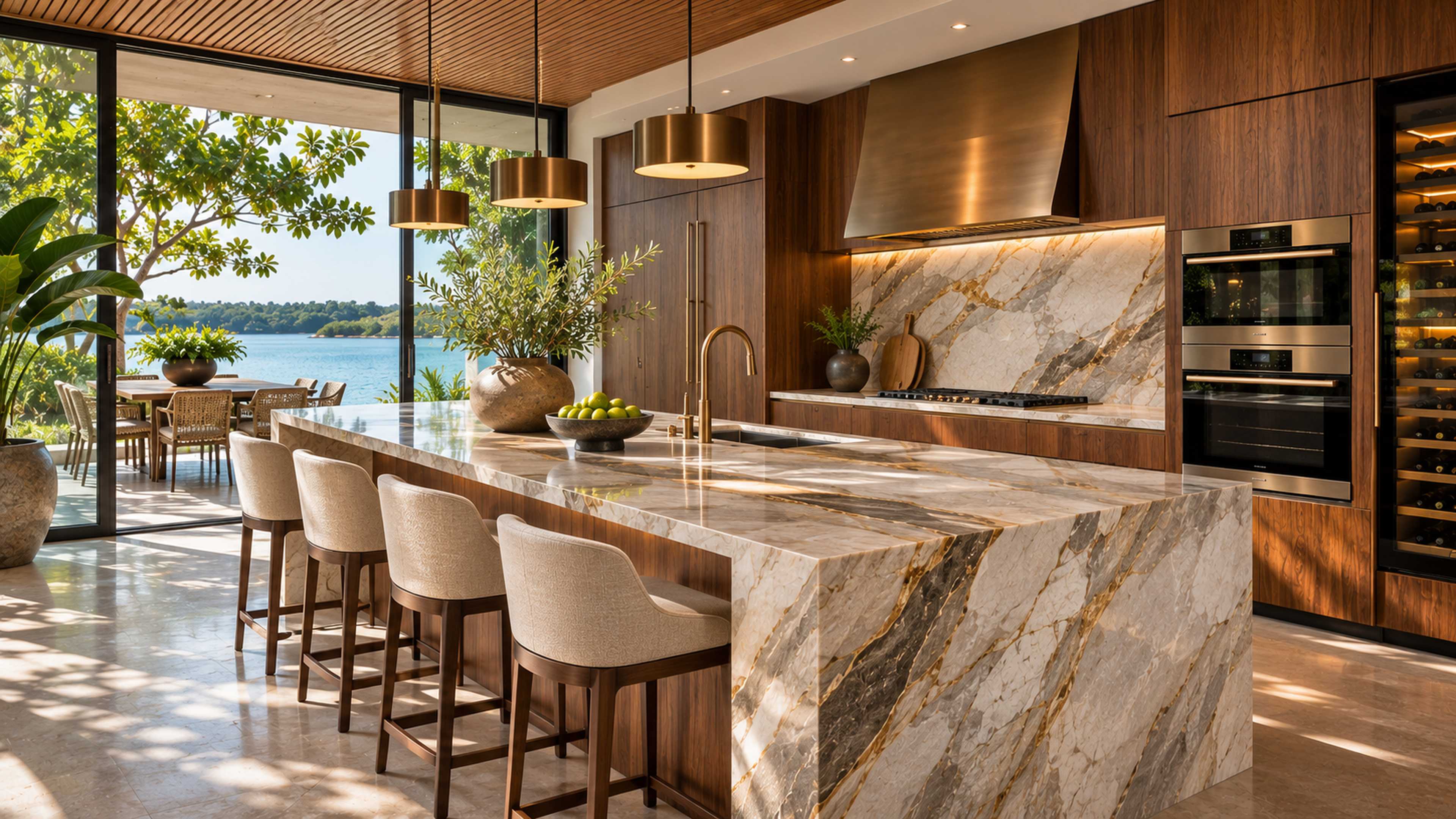
A material swatch isolated against an empty background offers very different information from a surface appearing within an architectural composition. At the scale of a kitchen frame, for instance, one might use oak cabinetry as an intermediate field in relation to stone and more distant space. A carefully composed image could show enough of both materials to establish the visual relation while resisting the temptation to transform the kitchen into a catalog of designed objects. A detail image of the bath might instead emphasize the relative perception of wood, stone and the light from its garden window. Neither interpretation needs to name brands or assign materials to details absent from the narration.
There is a limit to what finer detail can demonstrate. Generative imagery can supply extremely plausible-looking grain or texture even when the source does not identify a species or finish. Enlargement alone does not turn detail into documentation. In particular, digital renderers may produce highly persuasive surface highlights without proving what the represented surfaces would feel like or how they would age. Descriptions of material quality in this feature refer to the perceptual proposition, not an actual sample that has been inspected. Stone and oak are useful identifiers because they are part of the approved source, not because the film substitutes for physical evidence.
For a visual storyteller, shifting distance is a way to give a material motif a different narrative task. Exterior stone can make the spectator initially aware of a visual mass; the kitchen can make the same category of substance imaginable at working distance; the bath can make it part of the experience of a more contained scene. This is not a claim that all three places use the same stone. It is an opportunity to learn how visual recognition travels through a sequence of images. On a second viewing try following not the outline of the house, but the scale at which an identifiable material becomes perceptible. The film begins to suggest a new itinerary, one traversed entirely by attention.
5. The screen's north is not the house's north
Two useful orientation clues appear in the narration: the kitchen lies north of the main living area, and dining occupies a southern position relative to it. The later primary suite is at the quieter southern end upstairs. These are directional statements within the imagined architecture. They are not instructions about the direction a spectator should look across a screen. This distinction matters when an audience begins mentally joining separate cinematic spaces. It is possible to feel wonderfully oriented while getting the plan of a building entirely wrong.
In conventional film editing, continuity can be established by preserving or deliberately altering the direction of a subject's perceived movement between images. When the subject is architecture rather than an individual crossing a room, the equivalents may be the direction of a view, the apparent continuation of an edge, or a repeated object of attention. These can help the spectator organize a sequence, but a shift of camera position can change their projected direction in the frame. Even if a viewer is certain that a door or a panorama appeared on one side of an image, the conclusion that the corresponding place lies on that side of a house viewed from above does not automatically follow.
Here the directional descriptions are helpful precisely because they are independent of any speculative framing. A viewer need not guess which neighbor of the shared room is described as northern and which is southern. The narration supplies that relationship. It provides relatively sparse but useful anchors for a mental diagram: shared living, kitchen on one side of the conceptual center, dining on the other, and a private suite upstairs in the southern part. Adding further connections purely because they would make a pleasing layout would exceed the available evidence. For example, the southern identification does not establish whether dining is exactly below the suite, or whether those rooms have coincident footprints.
Try sketching this distinction on a blank piece of paper while watching. Write just the names of the named spaces and connect the ones that the narration explicitly relates. Use a different kind of mark for routes you are merely imagining from transitions in the film. A complete top-down plan is not the desired product. Instead, the sketch records the limitations of what is known. It is also an entertaining demonstration of the way viewers routinely synthesize fragments into a convincing mental place even without having enough information to draw a building.
The same awareness helps when making illustrations. A cinematic image of the kitchen can emphasize stone planes, oak and a sense of extended space beyond, without showing an invented panorama belonging to a particular compass bearing. The suite can retain the roof, the water relation and the subdued character of the scene without suggesting the viewer has been given a verified plan of its connection to the bath. Preserve the directional statements in accompanying editorial text, but do not manufacture architectural geography in order to convert them into a literal sightline.
In this way the film can appeal to two quite different sorts of spectator. Some people like to imagine the plan behind every image and will enjoy the effort of assembling a likely arrangement. Others prefer to attend to a single moment rather than attempt any reconstruction. The source supports elements of both experiences. It supplies an internal directional vocabulary and also individual places with a strong enough identity to be considered on their own. Recognizing the difference allows us to enjoy a feeling of coherence without asking that feeling to serve as proof of measured spatial accuracy. On repeat viewing the architecture becomes a developing mental model, and the reliability of that model is itself an interesting subject.
6. The missing interval between one place and the next
A familiar experience of watching a film is to accept a transition with remarkably little information. We see one location, then another, and infer a connection that may never have been fully represented. A tour of a virtual residence can invite that inference especially strongly, since the name of the film encourages the audience to believe that every episode belongs to the same place. Lagoon-Side Residence gives a useful opportunity to distinguish the connections supplied by its narrative from the intervening journeys that a spectator might imagine.
For instance, the narrator introduces an entrance that is set back beneath the roof and then an interior procession, pale stone and an overhead oval opening. One might mentally connect the two descriptions by imagining oneself passing from the second scene into the third. There is good reason to do so at the broadest level: their stated subjects are arrival and the beginning of the interior. But the route that fills the interval remains unspecified. A film critic should avoid calling it a continuous tracking shot or describing a particular alignment between the door and the skylight when those details have not been verified. What is interesting is how little information is required for the viewer to expect continuity.
Compare that with a more distant conceptual transition, from the terrace episode to the gallery. By this point the viewer has accumulated knowledge of the house's water association. A return to a raised position over the main shared interior need not mean that the film has visually accounted for every intervening movement from outside to upstairs. The audience can still recognize a coherent architectural subject. The distinction becomes apparent if you ask whether you could walk a route based solely on the information that you have been given. Recognition of a place and navigation through it are separate accomplishments. This film is an opportunity to explore the first without claiming the second.
Editing can use such omissions to concentrate attention. If a film actually showed every portion of a route, a great deal of screen time might be spent moving between the most distinctive episodes. Conversely, if there were no intelligible relationships among the episodes, the sequence could feel interchangeable, more like an anthology of unrelated design images. The approved descriptions establish a number of clear relationships that can sustain the audience through omitted intervals. The stairs belong to the two-level interior; the gallery relates to the central living volume; the water-directed rooms give recurring points of recognition. An editor working from this concept has enough material to make the audience do a useful share of the connecting work.
What would happen if the sequence were presented as a collection of shuffled stills? Many spectators might still recognize related forms and subjects, but the process of discovery would be different. Some connections announced by the narration might become less apparent, while new accidental associations could emerge from juxtaposition. The fact that the approved episodes have an order is therefore relevant even though their precise timing is not documented here. Order controls when one piece of information becomes available in relation to another. It can change which part of an image seems familiar and which part seems surprising.
The missing interval is particularly relevant for AI architecture because generative tools do not automatically ensure the existence of a coherent three-dimensional scene behind a succession of two-dimensional views. Visual plausibility should not be confused with geometric verification. An illustrator can respect the established source relationships while remaining explicit that new stills are interpretations, rather than images extracted from a fully mapped digital model. For the viewer, that distinction opens up a more revealing question than whether a render looks sufficiently realistic: which relationships can actually be established from this sequence, and which have been supplied by one's imagination?
7. Learning to see a light source without measuring it
Natural illumination can be interpreted in a film before it becomes the subject of a technical study. Here three descriptions provide especially interesting contrasts for a spectator: the oval skylight in the entrance sequence, the daylight filtering into the primary suite, and the fading daylight of the conclusion. Add the large glazed elevation associated with the living area and the garden window connected to the bath, and it becomes possible to consider the film through a set of different light-related visual cues rather than through a sequence of attractive rooms.
Begin with the overhead opening. An image in which a luminous area lies above the principal architecture can produce a very different pattern of visual search from an image in which the brightness is concentrated behind distant glazing. The spectator might look up, then find the nearest architectural contour against the light. An oval is also a shape with a visually comprehensible perimeter, so it offers a potential reference against which the eye can judge the surrounding forms. A new illustrative interpretation could emphasize this relation between a recognizable opening and the pale surfaces below it, without pretending to reproduce a particular image in the film.
Now consider the description of filtered daylight in the suite. The key photographic opportunity here is not necessarily to show a visibly identifiable filtering device. No such device is specified. It is to allow a more diffuse tonal passage to communicate a different sort of attention. If the entire image is uniformly bright, a gentle progression of tones might become impossible to distinguish. If contrast is exaggerated, a scene meant to evoke a quieter experience might turn into another theatrical reveal. These are choices for an image-maker exploring the narrated condition, not evidence of what the actual image's histogram or exposure settings would show.
The conclusion adds the dimension of change. The narrator establishes that daylight is declining. We do not know whether the transition is portrayed through a continuous temporal change, a cut, or another arrangement. What can be considered is the potential effect of an audience recognizing a previously introduced architectural subject under different illumination. Familiar outlines may acquire renewed importance as the difference between foreground and distance changes. A spectator might notice a relationship previously masked by the immediate appeal of the brighter daytime setting. Such an effect is a visual hypothesis, not a claim that a specified surface was illuminated at a particular intensity.
There is another reason to avoid treating these descriptions as literal evidence of lighting performance. A camera, a rendering system, and a display all transform brightness. Two spaces with very different actual light levels can be portrayed with roughly similar overall image brightness; a single space can be made to appear dramatically different by a change in rendering decisions. Human eyes also adapt when moving among conditions. A beautiful image of a skylight therefore does not yield a reliable reading of illumination on the stair. The same is true of the possibility of filtered light in the suite or of visibility after sunset.
For a repeat viewing, the most useful experiment is qualitative. Notice where in each passage you first become aware of light, then notice which subject becomes easier to distinguish because of that cue. Consider whether the brightness seems tied to an identifiable opening, an extended outdoor field, or the general atmosphere of the image. This exercise makes the naturally lit spaces more differentiated without asking us to imagine a sun path or infer the performance of a particular window. It is a way of attending to light as a storyteller: what information does its apparent distribution give the eye, and how does that information change when the narrative introduces a different place or time?
8. The little visual measurements your imagination makes
Architecture rendered on a screen creates an odd problem of scale. An image may fill the display regardless of whether its subject is a whole building or a small portion of an interior. Much of what lets us experience one as considerably larger than the other is knowledge supplied by familiar objects. In Lagoon-Side Residence, the narrated stair, doorway, cabinetry, table and furnishings in the suite furnish several possible cues. The great glazed living elevation and the roof contours, by contrast, give the spectator larger relationships to consider. Together the episodes invite a study of perceived size that does not require imaginary numerical measurements.
The stair is an especially interesting subject because its components imply a relation to a body. A single sloping surface might be difficult to interpret as a route, even in a visually accomplished image. Visible steps tell a different story. Their succession lets the audience imagine increments of movement. A substantial intermediate landing offers another reference, and a guard helps the audience recognize a boundary between a route and adjacent space. None of these observations supplies an actual tread depth or a verified guard height. They concern the kinds of forms that the viewer recognizes and the implicit physical expectations those forms call up.
The table and cabinetry introduce a different register of familiarity. We tend to recognize the scale of common domestic functions even when the specific objects represented are unfamiliar. In a possible dining composition the table could give a spectator a point of comparison with the overhead plane. In a possible kitchen image the area of the stone work surface in relation to the cabinetry could establish a more immediate sense of domestic rather than monumental scale. This is not a description of exact furniture or cabinet dimensions in the film. It is a way of using the approved objects as reference points when considering the architecture's visual representation.
What happens when an image-maker's pursuit of a striking perspective gets in the way of these cues? Very pronounced wide-angle exaggeration can expand the apparent depth of a room, for example, while magnifying near objects in relation to distant ones. Without a suitably intelligible visual reference, an audience may come away with a very different idea of proportions from the one suggested by the narration. There is no basis in the dossier for identifying the lens equivalents used in the film itself. But the broader question is valuable for anyone producing new editorial imagery in its spirit. A dramatic view is not necessarily the most informative view.
There is a related mistake in reading the exterior. One cannot reliably work backward from the curve of the roof in an attractive image to its actual radius, or from the apparent nearness of water to a horizontal distance measured on the ground. A shape changes its appearance when represented from different positions. In the closing architectural composition, a familiar visual relationship may be recognized even if its apparent dimensions have altered through changes in representation. The source gives enough to identify the shared vocabulary of the exterior, but it does not turn the sequence into a calibrated photographic survey.
For readers who enjoy architecture films, it is worth repeating this exercise with the sound off on a second pass. Where does your perception of size come from? What happens when there is no obvious everyday reference? On a third pass restore the narration and see whether it identifies objects or relations you had previously overlooked. The purpose is not to catch the film making an error; there is no measured building here against which to test such a claim. It is to become more aware of how the eye uses known categories to comprehend an unfamiliar composition. The virtual house becomes a laboratory for our own visual habits.
9. Reading the quietest image as a counter-image

A highly distinctive feature of the source is the change in outward subject between the lagoon-directed spaces and the private bath. Instead of seeking a rival spectacle for the latter, the narration gives it a garden window. Think of this as an opportunity for a counter-image: an episode that helps define another episode by offering a different visual proposition. The bath need not be judged according to whether it delivers the same kind of vista as the primary living space. The interest is in the comparison itself.
The audience acquires a set of expectations from early references to water. The initial exterior and subsequent principal living space make the lagoon an obvious subject to remember. When the narrative mentions the garden window, it can redirect that expectation. The imagined scope of attention has changed. The landscape has not simply been withdrawn from all view, nor is it necessary to invent another large exterior prospect. A limited opening can become a point of visual significance precisely when the audience has grown accustomed to a much more expansive one elsewhere.
An editor working with this idea could juxtapose a garden-window interpretation and the opening exterior without attempting to make them equivalent. The first might make the spectator particularly aware of material immediately around a window; the second might be more concerned with the outline of the architecture in its waterside context. The relation between the pictures would be based on difference of visual reach, not on a claim that their depicted sites can be mapped together. If the bath image were reduced to a photograph of luxurious fittings, that conceptual comparison would be weaker. If it included an invented waterfront beyond the garden, it would alter the source proposition.
This is also a useful way to think about attention in the primary suite. The narrator's emphasis on a roof, moderated daylight, restrained furnishings and the lagoon outlook means the suite need not be shown as a display of collectibles. A new illustration can allow a relatively unremarkable furniture arrangement to recede within an architectural image. The absence of distracting objects should not be embellished into a claim about the owner's personality, habits or possessions. Rather, the source describes a tonal and spatial proposition whose meaning can be explored by attending to what is visually prominent and what is not.
A counter-image works partly because the audience remembers what has preceded it. For a sequence assembled solely from miniature previews, the quieter images may sometimes feel less striking than the exterior or main central space. Viewed as a film, their significance can be enhanced by contrast with other episodes. This suggests an editorial criterion different from maximizing the appeal of every individual thumbnail. The value of a particular image may be what it changes in the audience's understanding of another. An architecture film can invite successive shifts of attention rather than asking for the same response to every picture.
One can imagine a useful exercise for a design discussion: choose two passages that seem least alike and identify a question that can be asked of both. For the bath and the central view, that question might be how much exterior information an interior image gives the spectator. Try relating the garden window to the suite's outward reference as well. Each establishes a different balance of nearby architecture and beyond, yet the juxtaposition does not require a precise floor plan. It makes an apparently minor scene an interpretive key to the larger subject. The private bath, in other words, is worth remembering not because it must rival the panoramic image, but because it can help us understand what makes that panorama notable in the first place.
10. The words and pictures need not race each other
The approved narration gives the writer a surprisingly compact set of visual propositions. Relatively few sentences specify the things to which an audience should attend: a curve, a lowered portion of roof, textured material, a particular opening, a route between levels, a stretch of glazing, a place to eat or prepare food. These propositions are enough to make a lengthy visual conversation possible, yet their economy is itself worth considering. A voice describing an architectural image can give the audience direction without supplying an exhaustive verbal substitute for the picture.
There are different ways to build that relationship in cinema. A narration might identify something that has not yet become the viewer's principal object of attention. It might name a relationship already perceived but not fully understood. Or it might supply information that would be difficult to infer visually, such as the internal directional labels given to the kitchen and dining area. We cannot reconstruct the exact synchronization of the audio and each image from the supplied evidence. Still, we can recognize those different types of information at work in the approved language, and think about how they would affect a spectator's reading of the resulting film.
The entrance sequence provides an example of what a verbal cue can do. Knowing that the screens are bronze focuses attention differently from being told only to admire the entrance. The inclusion of a recess among the architectural descriptions encourages attention to depth rather than just visual finish. Such information has value even for a spectator who initially responds to the image on a purely aesthetic level. It asks the audience to look for something more definite, and possibly to revise a first impression. It does not require the narrator to identify every object the picture may happen to contain.
By contrast, internal directions such as north and south contribute relationships that are not necessarily self-evident in an isolated image. They can be thought of as a compact verbal annotation to the visual material. A spectator who hears these cues may begin to form a more stable understanding of the relative functions surrounding the shared center. The narration gives a useful distinction that would be difficult to supply simply by enlarging the image. This division of labor between words and pictures is one of the benefits of watching a narrated film rather than consuming only a stream of individual architecture images.
The same principle applies to supplemental editorial imagery. A caption should make clear that a new image is an illustrative interpretation of a fictional concept, and should identify the source relationship being explored. It should not try to compensate for uncertainties by giving the image an invented production history. New artwork need not pretend to be a film frame to be useful. It can offer a different visual arrangement of documented concepts, bringing one particular relationship into prominence so that readers return to the actual tour with a more attentive eye. The surrounding editorial text can identify what is known and what has been chosen for the illustration.
There is a pleasing asymmetry here. The written word can specify the relationship between two otherwise isolated places; the visual sequence can give a spectator an impression of depth or relative scale that would be tedious to describe exhaustively. Neither medium needs to duplicate the entire work of the other. As you revisit the tour, pay attention to the moments when a word changes the way you look, rather than counting the number of objects the narrator describes. That change of attention is one of the most direct ways in which a narrated architectural film can teach an audience something about the act of seeing.
11. What remains in the mind after the film ends
The last passage supplies an evening condition and a return to the residence as a whole. It is a fitting moment to test the title of this feature. We can ask what information a spectator brings to that final architectural image that was unavailable at the outset. The answer will be different for different viewers, but it is unlikely to be restricted to the number of rooms they have been introduced to. The spectator now has a set of possible associations between a roof form, an interior volume, several kinds of opening and different ways of attending to a landscape.
It is useful to resist the temptation to locate every instance of that knowledge inside the final exterior. The source does not establish exactly which rooms, objects or windows can be seen there. A viewer might register the whole house and nevertheless be imagining spaces that are hidden from the represented position. This extra layer of awareness is something that the intervening images and words have contributed. It is analogous to revisiting the opening description after reading the entire narrative: the same subject may now be surrounded by different expectations, whether or not the representation changes dramatically.
If the film were a still image shown twice with no intervening content, the second viewing might reveal some overlooked detail. In an ordered series of architectural passages, there is an additional possibility. The audience can learn relationships from one image that transform the significance of another. The gallery and living space are particularly clear examples because the source directly relates them. The entrance and the bath offer a different kind of association, grounded in the ways the descriptions make the viewer aware of edges and limited access to information. These comparisons help the concept outlive the individual images used to introduce it.
The viewing experiment need not end with the conclusion. Return to the beginning and try a new route of attention. Instead of following the lagoon immediately, look for a visual reference that might help you recognize the architecture later. When the narrative introduces domestic spaces, notice which earlier elements you instinctively connect with them. Distinguish between a connection declared in the narration, a plausible visual association, and a connection you have invented because the overall house feels convincing. This is especially useful when viewing generated architecture: one can be enthusiastic about the visual experience while remaining precise about the knowledge it actually supplies.
The film belongs to the imaginative realm of architecture, where a viewer can explore the implications of a design without mistaking a representation for an existing property. A complete spatial reconstruction or a judgment of physical performance would require independent information far beyond this dossier. The interest of this sequence lies elsewhere. It offers a set of visually and verbally related episodes in which spectators can examine their own formation of architectural memory. One may remember the stairs more clearly through thinking about the table, or the large window through considering the garden-directed bath. Such associations are not evidence of physical adjacency. They are a record of how the audience learned to attend to the concept.
Watch Lagoon-Side Residence — Full Architectural Tour again and choose one relationship rather than one favorite image. Which two passages changed each other's meaning for you? That is a question worth bringing to other architecture films as well. It moves the conversation from a competition among impressive views toward an appreciation of the experience created by a sequence. What makes the residence interesting to return to is that the act of looking can be different the second time, even when the house on the screen remains the same.


